I agree with the path proposed by @danielf15
This is a solid plan.
is anybody still defending buyback + burn or do we all agree that buyback + redistribute is a better way forward ?
2 Likes
If buybacks are considered, the “distribute” model is the only one I would support. They could airdrop infinite veDUST NFTs proportional to the pool share percentage at an end of epoch snapshot.
2 Likes
I fully agree with @danielf15. If it comes to a vote I will vote yes on his suggestion. Anything else, I will be voting no.
This is a pretty good suggestion. When you refer to existing pool, you mean the Balancer pool?
1 Like
Correct @nykon1293 , i meant the balancer pool.
2 Likes
Thank you @0xTuongLam for taking the time to put up this proposal. It is a good base to trigger discussions on this topic.
I personally is also in agreement with what @danielf15 proposed. The only thing which I might like to clarify is on point 3 of the problem statement:
“Reflexive design. The yield that justifies locking into veDUST is itself funded by emissions. When DUST falls, that yield falls with it, which weakens the incentive to lock at the exact moment selling pressure is highest. This is the loop that produces the incident, and it repeats unless the design changes.”
I am of the impression that the payout to veDUST is based upon revenue being distributed rather than it being based on emissions.
As for the pool as pointed out by @deerdragon_02558, having a V2 pool as a resilience pool for liquidity makes sense. In the event of another dump, the price of DUST might plummet, but I guess it will impact whoever is selling as well, rather than them being able to drain out all the USDC at a higher price. I think it was mentioned in one of the chats that it is also suggested by discussions with the Balancer team to have a weighted pool. So I guess that would probably help to maintain liquidity with some efficiency. As for the ratio between the 2 pools, be it 50/50, 60/40 or 70/30, I guess there would have been guidance from the Balancer team. I would suggest that if there is going to be a protocol owned liquidity pool, perhaps that be used to form the basis for the the resilience pool.
Just read this in Balancer documentation.
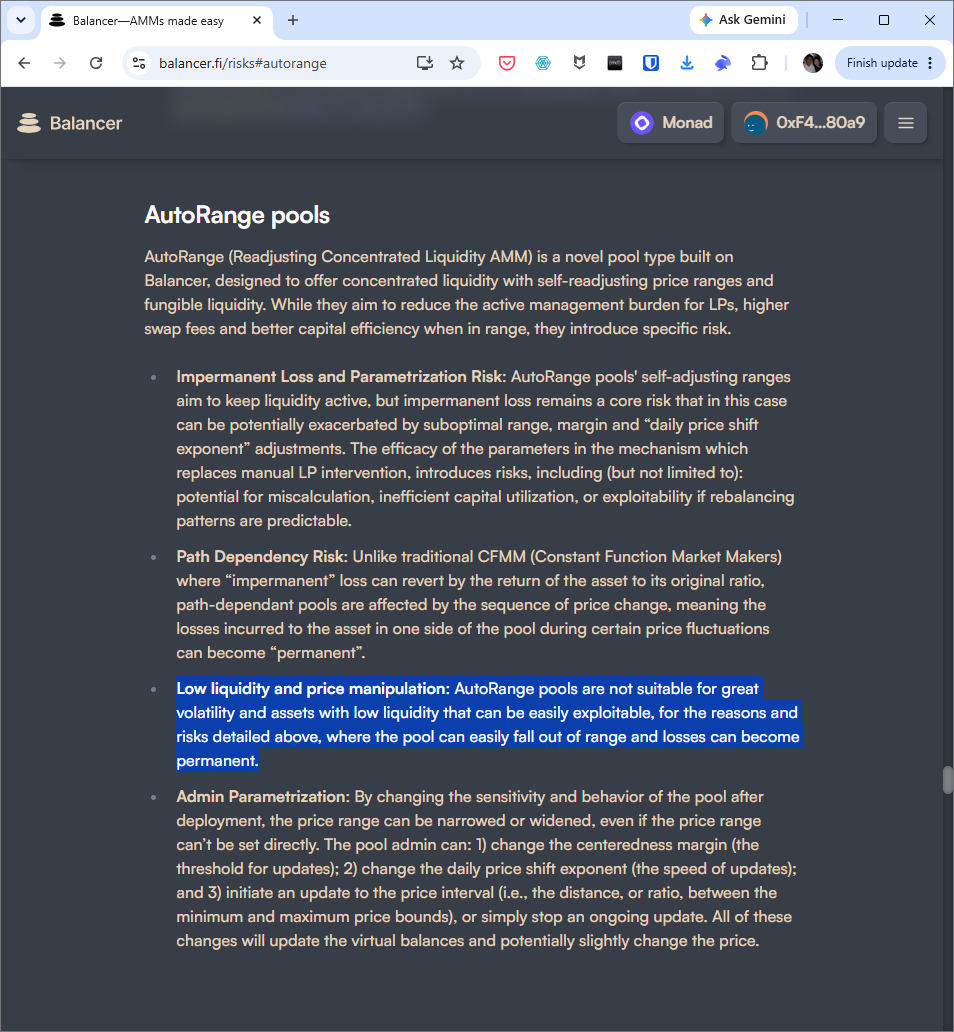
Considering the low liquidity of DUST, should we still be even be aiming for efficiency with the Balancer Autorange pool? Maybe most of the protocol owned liquidity should just be in a V2 (weighted) pool and not be in the V3 pool?
2 Likes
Solid suggestions. Agreed on all three points. Focus on believers (long time holders) is the way to go.
This is a short term fix that doesn’t solve the underlying problem as many have suggested. Emission rates need reduced and a fix for short locks that have increased burn penalty that degrades for longer locks would need to accompany the liquidity fix or we will keep returning to it every four weeks.
I agree with the proposed by dani
My comment is offers no solution, but addresses a major risk of this proposal.
By reducing veDUST from 70% to 20%, for 4 weeks will lead to a mass exodus in TVL. **Especially for weth, the bitcoins and stables
Personally, I keep certain assets on Neverland rather than elsewhere in effort to support the protocol, at the expense of earning higher apy elsewhere. However, most people see that high $dust incentive and choose Neverland because of it. A cut that large and for that long is just dangerous.
1 Like
i guess we are more focus on TVL instead of token price.. lets think about this..
Based on the recent changes to the LP incentives, do you want to refine what this RFC-06 proposes moving forward? Is there a consensus? Maybe there’s a need to update the original RFC to align with the latest changes, with a clear objective and a path to achieve it, so we can move it to a vote?
Tagging both for the original proposal and the alternative mentioned.
1 Like